Japanese jewellery brands are aiming to capture global audiences with their renowned craftsmanship and distinct design philosophy.
Wanami Maho, director of Overseas Business Development for Lifestyle Industries at the Japan External Trade Organization (JETRO), said Japanese jewellers could shine on the global stage by highlighting their heritage, the “Japan brand” image and exceptional techniques such as Raden (mother-of-pearl inlay in lacquer).
“The perception of Japanese jewellery has long been tied to pearls and pre-owned pieces. However, it goes beyond that. Japan has diverse designer brands and companies with unique production techniques,” noted Keita Nagahori, chairman of the Japan Jewellery Association (JJA).
He explained that Japanese artistry and aesthetics are rooted in rich history, traditional craftsmanship, cultural heritage and a profound sense of beauty.
JJA and JETRO co-organised the Japan Brand Pavilion at Jewellery & Gem WORLD Hong Kong (JGW) 2025 to promote Japanese jewellery brands to international markets.
Three prominent Japanese jewellers – Abheri, Okurado and Kaji Jewellery Art – sat down with JNA to talk about their business philosophy and growth strategies.
AbHeri: Modern Japanese designs
AbHeri’s name originates from the Latin words “Ab,” meaning pursuit and “Heri,” meaning yesterday, embodying a philosophy of honouring tradition while embracing new challenges. The company was established in 1986.
Yuiki Sya, head of International Sales at AbHeri, emphasised that all products are handcrafted by in-house artisans using premium materials like 18-karat gold, platinum and natural diamonds and gemstones. Its signature line, Reticella was inspired by medieval European lace and has garnered acclaim in global markets.

Chain ring by AbHeri
The brand primarily targeted top-spending female clients, but plans to create new men's collections are underway, bolstered by rising demand for men's jewellery.
The company operates three stores in Tokyo and Osaka alongside authorised retail outlets. With a solid footing in Japan and a presence in Hong Kong, Shanghai and Singapore, AbHeri is leveraging its participation at international trade shows to further expand into European and Middle Eastern markets.
“Japan's domestic economy has stagnated in recent years. While the local jewellery market experienced a downturn, our overseas business is growing steadily, with over half of our enquiries coming from abroad. Hence, we aim to expand our overseas business moving forward,” said Sya.
Okurado: Hallmark of Japanese elegance
Founded in 1969, the family-run atelier Okurado creates pieces entirely in-house – from design to final polish, with a mission to showcase Japanese aesthetics through high-end jewellery.
Second-generation owner Hitoshi Okura, also president of the company, said his designs draw inspiration from Japan's natural beauty and traditional architecture. Motifs like cherry blossoms, four seasons and Kyoto's circular temple windows, to name a few, embody the subtle elegance revered in Japanese culture.
“Each piece is emotionally resonant, reflecting refined sophistication over extravagance,” said Okura. He also identified an appreciation for asymmetry and “breathing space” as key features of his designs, adding that these details give the pieces their distinctively Japanese character.
“Clients increasingly seek truly distinctive jewellery – pieces that are one of a kind rather than mass-produced items. This preference is growing steadily, so we offer exclusive items to cater to this demand, as well as customised jewellery,” said Okura.
While Okurado's current clientele is mainly local, the brand aims to attract discerning buyers worldwide, particularly in China and Southeast Asia.

Necklace from Okurado's Leaves Collection
Kaji Jewellery Art: Timeless jewellery masterpieces
Kaji Jewellery Art stands as a renowned luxury jewellery brand, targeting collectors who seek exceptional and artistic pieces.
For Mitsuo Kaji, founder of Kaji Jewellery Art, the vision has always been to blend classic and modern themes. With a legacy spanning 45 years, Kaji is dedicated to crafting jewellery that carry engaging stories and cultural significance, a quality highly valued in European markets where jewellery is seen as an artistic creation.
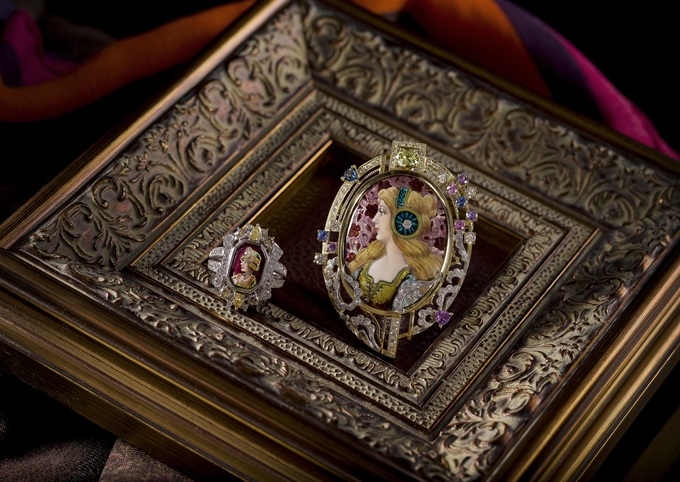
Mitsuo is known for his mastery of émaux (French artistic enamel) jewellery, a technique he revitalised with distinctive frame designs that harmonise tradition with modern aesthetics.
“I regard it as a true gem crafted by human hands,” said Mitsuo. “Each piece exudes a unique play of colour and radiance, brimming with vitality and artistry that cannot be found in today’s mass-produced jewellery.”

Jewellery by Kaji Jewellery Art
He believed the greatest strength of Japanese jewellery brands lies in an unwavering commitment to perfecting the finest detail and in refined craftsmanship honed over generations. Unfortunately, the values and philosophies embedded in these creations are not yet effectively conveyed to the world through storytelling.
Moving forward, Mitsuo will focus on crafting enduring designs, ensuring that Japan's exceptional craftsmanship is passed down to future generations. Recently, the company finalised a volleyball-sized objet d'art inspired by Mont-Saint-Michel, a UNESCO World Heritage site in France.