The Gemological Institute of America (GIA) is stepping up its origin determination and treatment detection services for coloured gemstones amid heightened market interest in provenance and responsible sourcing.
This article first appeared in GEMSWORLD 2026.
Coloured stones is a major focus for the Gemological Institute of America (GIA) as more markets develop an appreciation for gemstones.
GIA has observed a significant increase in coloured gemstones submitted for testing as it steadily expands its network of laboratories worldwide, according to Shane McClure, global director of GIA Colored Stone Services.
Enhanced offerings
Origin determination and treatment detection are the primary reasons for most testing submissions, prompting GIA to expand its offerings in these areas.
Opal, peridot and demantoid garnet were added to GIA’s origin-determination service on January 1, 2026. This follows the 2025 launch of a service for untreated jadeite jade and omphacite jade to determine whether the jade originated from Myanmar or Guatemala.
GIA country-of-origin service is also available for alexandrite, emerald, Paraiba tourmaline, red spinel, ruby and sapphire.
“Our expanded services are based on GIA’s extensive research and collection of 32,000 samples collected by GIA field gemmologists,” said McClure. “The institute started coloured stone reporting more than 75 years ago and since then, researchers and gemmologists across our laboratories have developed an industry-leading knowledge. This expertise, as well as GIA’s decades-long commitment to research, underpin our report results.”
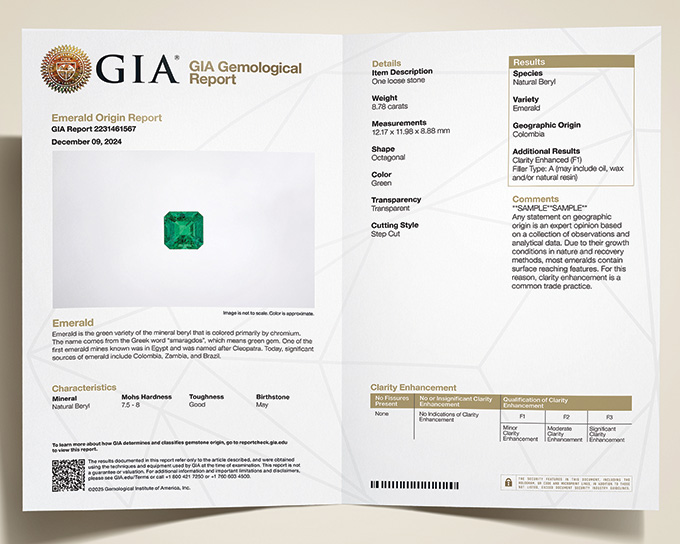
GIA’s full suite of gemmological reports for coloured gemstones have also undergone a substantial upgrade. The redesigned reports feature an elevated layout that highlights more gemmological information for enhanced storytelling.
Weight categories and fee structures for coloured stone submissions have likewise been revised.
Treatment detection
Identifying treatments is another primary concern of gemstone buyers. GIA is vigilant about any new developments in treatments that modify the appearance or properties of coloured gemstones.
It reintroduced filler identification to its gemmological reports for emeralds at no additional cost in late 2024 and witnessed strong demand for the service throughout 2025. GIA will start charging for this report enhancement to identify filler material in emeralds in 2026.
In an earlier interview, GIA Executive Vice President and Chief Laboratory and Research Officer Tom Moses said this strategic move was sparked by major US and European brands increasingly requesting for precise and up-to-date gemmological analysis.
Meanwhile, well-known treatments such as the heating of rubies and sapphires continue to be prevalent in the market, said McClure. Clarity enhancement, which has typically been associated with emerald, is also appearing in many other coloured gemstones, most notably tourmaline.
Challenges remain in detecting certain treatments. For instance, irradiation of some types of coloured gemstones still cannot be detected.
“We are however constantly watching for new applications of existing treatments and the possibility of new methods. In 2023, we discovered cobalt diffusion being used to change the colour of spinel,” McClure remarked.
Tech and education
On the technology front, GIA is using machine learning and artificial intelligence (AI) to assist its skilled gemmologists and laboratory staff. For coloured stone services, the objective in using these advanced technologies is to increase efficiency by examining more gemstones and delivering results faster.
“AI and machine learning are most effective as additions to our current methods for determining geographic origin. Experienced gemmologists review all recommendations from these systems before making a final determination,” noted McClure. “At present, complex origin determinations and treatment examinations are beyond the capabilities of AI or machine learning.”
GIA’s commitment to the coloured stone sector extends to education. New modules on coloured gemstones and jewellery are being developed for the GIA NextGem programme that consists of short high-quality, on-demand training courses for retail associates to broaden the learning experience.
McClure said, “We believe that our combination of extensive research, including our large coloured stone reference collection and comprehensive gemmological database, along with advanced tools and highly skilled gemmologists and laboratory staff, positions us to deliver services that meet the needs of the trade.”