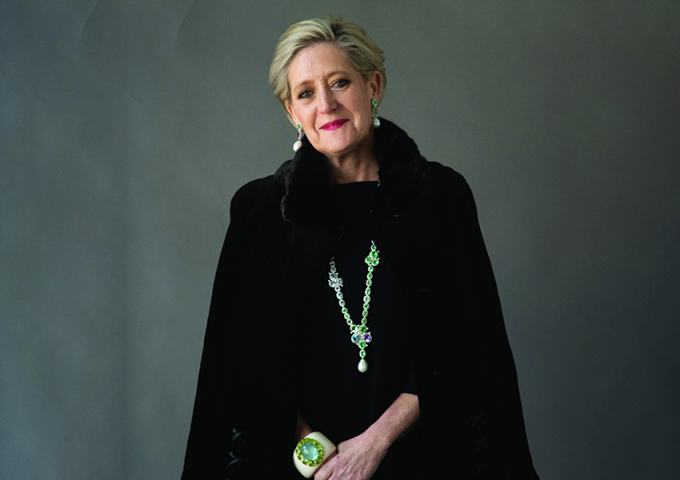
JNA delves into the creative processes and design philosophies of three female visionaries known for their bold and exceptional pearl jewellery collections.
The connection among jewellery designers Margot McKinney of Australia, Melanie Georgacopoulos of Greece and Mizuki Goltz of Japan goes beyond their shared affinity for pearls. Their daringly distinctive designs – spanning three continents – have set the bar higher for modern, reinvented pearl jewellery pieces.
MARGOT MCKINNEY
A fourth-generation jeweller, Margot McKinney of Australia crafts one-of-a-kind statement pieces inspired by the “exotic abundance” of the natural world.
Does wearing pearls today, at a time when nature faces many threats, carry a special meaning?
McKinney: The pearl is an enduring symbol and women have been wearing it for centuries. It’s also worth noting that pearls are the only gems that originate from a living organism. Every year, at harvest time, I visit the farm I source my pearls from. It is located in one of the most remote places on earth, northeast of Australia. To produce the finest pearls, both land and sea must be kept in pristine condition. Extraordinary oysters grow and thrive in an environmentally sustainable setting. Pearl producers must also pay respect to aboriginal communities. Wearing beautiful pearls is thus about living in harmony with nature.
How do baroque pearls and strands of perfectly matched round pearls figure in your designs?
McKinney: Baroque pearls have a one-of-a-kind character. I often tell my clients that each pearl is different. Some baroque pearls stand out from the time they emerge from the oyster. What I do is I design around those pearls. On the other hand, I deeply appreciate fine round pearls for their rarity. These are more difficult to grow and represent only four per cent of a harvest. Round pearls attract a premium since extremely unique pieces are highly sought after. To put together a strand of round pearls, we go through hundreds of thousands of gems. I have one of the biggest collections of perfectly matched round pearl strands, which took 10 years to curate. Waiting for perfection is an exercise in patience.
Colours are an important element of your jewellery. How do you adapt these to pearls?
McKinney: Many of my collector clients own a pearl strand but they also want pearl jewellery to match with other colours. I use all types of coloured gemstones to bring out the pearl’s colour. For instance, pink sapphires or tourmalines complement pearls with a rosy overtone. I also just designed a piece using kunzite with a hint of purple. Our pearls, which have thick nacre and deep lustre, meld perfectly with coloured gemstones. I also have a love affair with opals, not only because I’m from Australia. Boulder opals, like baroque pearls, are enigmatic and their play of colour intrigues me. I love to frame opals with coloured gems, considering the opals’ predominant colours. Opals also fuse beautifully with pearls.
MELANIE GEORGACOPOULOS
Born and raised in Greece, London-based Melanie Georgacopoulos is making a name for herself as a creative and innovative contemporary pearl jewellery designer.
You have been collaborating with Japanese pearl expert Tasaki for eight years now. What are your most valuable takeaways?
Georgacopoulos: When you start your own company, you end up doing everything at first. It’s a great learning curve, but it’s also extremely difficult. I love working with Tasaki because everyone is efficient; every department aims for perfection, which is reflected in the end-product. One of the biggest lessons I learned is being part of the process and trusting others’ expertise. It’s inspiring to be surrounded and supported by experts who are there to help you. The Japanese also have a profound affinity for pearls. Visiting Tasaki’s pearl farm in Nagasaki was an intense experience. Over the years, I gained an even deeper understanding of pearls and what they mean to Japan culturally, which in turn, enabled me to appreciate pearls even more and push the boundaries of contemporary pearl jewellery design even further.
Your latest collections explore the design potential of mother-of-pearl. Does it get the attention it deserves as a luxury material?
Georgacopoulos: It’s a colourful and versatile material that has opened many design possibilities for me. I‘ve seen its potential explored significantly in watches but not in fine jewellery. There’s a common perception that mother-of-pearl is not as luxurious as pearls. But times are changing and customers are more receptive to different materials and interesting designs so I am optimistic. My collections are well-received because they stand out. People tell me they don’t see this kind of designs often.
You constantly reinvent pearl jewellery. What makes this specific gem fashionable and attractive today?
Georgacopoulos: It’s a timeless gem that’s subtler than a diamond. Pearls inject an additional dose of elegance to the wearer. I’ve worked with pearls over the last 10 years and designed more than 40 collections, but I still want to create. Pearls have become more mainstream since some big fashion houses started incorporating imitation pearls of all sizes in their designs over the past decade. It has become cool to wear pearls for the younger generation. Interesting and affordable pearl jewellery designs have also become increasingly available, resulting in more women embracing pearls and wearing them every day.
MIZUKI GOLTZ
Born in Tokyo and raised in New York, Mizuki Goltz marries western and eastern elements in her fashion-forward pearl jewellery collections.
How did your eastern heritage and western upbringing shape your personality?
Goltz: I was born in Japan and moved to the US when I was 10. Despite spending most of our time in the US, my family kept a strong connection to Japan. As a result, I feel fortunate to possess both sensibilities. The saying “you can’t see the forest for the trees” embodies my tendency to focus on the details and possibly lose myself in the process, which is an eastern trait. However, my western predisposition interprets this as knowing the trees more intimately and understanding the forest better. The balance and collision of ideas are beneficial to my creativity.
What makes pearls fashionable today?
Goltz: I embrace the original beauty of pearls because for me, pearls are the closest definition to being a woman. The female body, as one of the most beautiful forms, is always an inspiration. A lot of designs nowadays are done through computer programmes or 3D machines. In contrast, pearls are natural gems from a living specimen. Transforming pearls into jewellery pieces that accentuate a woman’s body, her individuality, sensuality and fashion sense is the perfect job for me. Pearls are sought after because they are rare, organic gems. Their perfections and imperfections make them unique, which is a precious commodity nowadays.
How do you choose pearls?
Goltz: I trust my instincts when designing my jewellery. I work more like a fashion designer than a jewellery craftsman. Emotions and senses play a big role in my creative process. I let subtle and unexpected moments take their course. What appears simple is the result of countless hours of reworking designs until I feel they are complete. In the end, the entire collection must reflect my vision as an artist and the identity of my brand. For instance, the size, shape and accessibility of pearls played a key role in defining my fine jewellery collection, Sea of Beauty. The pearls’ striking uniqueness meanwhile is the focus of my Privé collection.
Experts' corner
What would you tell young designers who want to work with pearls?
Margot McKinney
Bear in mind that pearls are the only gems that come from a living organism. Let that guide your work – keep it simple and humble. Designs do not have to be complicated so long as they accentuate the innate beauty of the pearl. It also pays to know the material you are working with. Some pearl farms wax and polish their pearls to enhance their beauty. Australian pearls meanwhile only need to be washed in warm soapy water for 30 minutes after being harvested. Pearls are truly naturally perfect gems and that’s at the core of their charm.
Melanie Georgacopoulos
Know what has come before and be eager to shape what lies ahead. Young designers must be willing to learn and always remain curious. When I started, I knew nothing about pearls. I sawed the first pearl I bought into two and was surprised that it resembled a tree trunk within – that’s the wonder of ignorance! So do not be afraid to embrace new ideas as there is always room for innovation. Good designs must represent current times but, more importantly, should look to the future. Always try to source your pearls from a sustainable farm.
Mizuki Goltz
Be original and stay true to your artistic vision. Designers need to be aware of trends but should not be influenced by what others are doing. Discover your own influences and then remove yourself from the picture so you can focus on the art. If you can do that, your voice will begin to come through. If not, you’ll be a version of what exists, and success will always be just out of reach. Very few artists are immediately successful. Many take years of hard work to discover their true vision. When you achieve that, it is amazing and all the work was worth it.